Sergeyich’s bee-bed
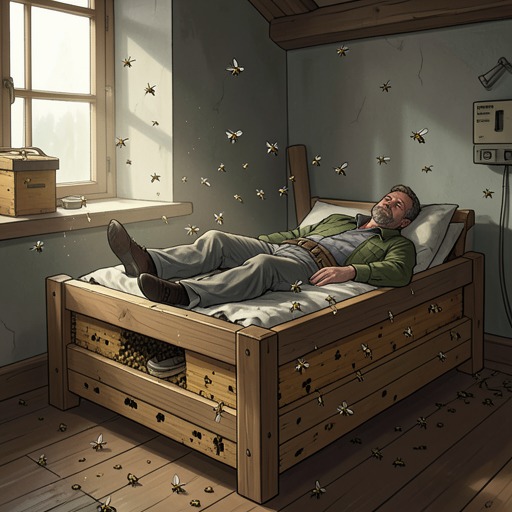
Grey BeesSergeyich’s bee-bed is a platform assembled over six beehives, with a sheet of wood and a thin, straw-filled mattress on top. Conceived as a place to rest amid the bees, it becomes at once a livelihood-enhancing curiosity, a coveted amenity for powerful visitors, and an image of the bodily calm Sergeyich hopes to recover. Its changing uses trace the distance between the peace of his earlier life and the precariousness of wartime displacement.
Construction and Use
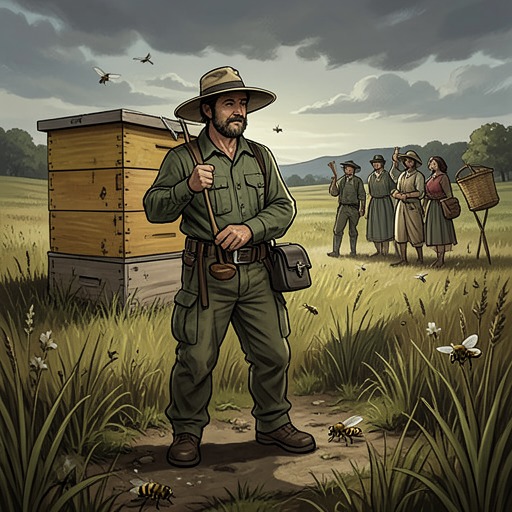
The bee-bed began as a beekeeper’s experiment, though Sergeyich credited the idea to a beekeeping magazine and took pride in having built the bed himself. In the orchard, six hives stood back to back in pairs; a wooden sheet bridged them, and a thin mattress stuffed with straw rested above. The arrangement brought a human body directly over the working colonies, turning the apiary into a place not only for tending bees but for lying still among them.
The governor’s first visit made the bed’s operation unusually public. After asking Sergeyich’s shoe size, the visitor climbed a step stool, lowered himself carefully onto the mattress, and lay on his right side. Sergeyich advised him that lying on his back would create the “Maximum connection between the body and the hives.” The governor then dismissed his host to take a nap, while his guards waited nearby. Left in the house, Sergeyich worried that the hives’ legs might collapse under the guest’s weight: when he had built them, he had been thinking only of the bees’ comfort, not of the supposed health benefits of sleeping above them.
A Public Attraction
The governor’s visits transformed the bee-bed from a private construction into a source of local standing. After his first nap, the governor gave Sergeyich three hundred dollars and a bottle of vodka. Neighbours who had previously disliked or ignored the beekeeper began greeting him cordially, as if his association with the powerful visitor had changed his status overnight.
A year later, Sergeyich had enclosed the bed in a small, lightweight gazebo that could be assembled or taken down in under an hour. He had made the mattress thinner, so that straw would not muffle even the faintest vibration from the hundreds of thousands of bees beneath it. The governor arrived with ten guards and a line of cars along Lenin Street, and spent five or six hours sleeping on—or simply lying on—the bed. He left Sergeyich a thousand dollars in an envelope and embraced him with such force that the gesture seemed a farewell to a dear friend. Sergeyich took the visit as a stroke of luck unlikely to happen again.
The expected third visit never quite took place. Sergeyich had been told to prepare for the governor’s return and waited through lunchtime into the afternoon. A single black jeep arrived instead of the several cars he remembered from earlier visits. The governor had been called back to Kyiv because circumstances were not looking good; his suited assistant came in his place. Sergeyich still laid a sheet over the mattress, intending it for the anticipated guest. The assistant tried the bed, but after about three minutes climbed down, uneasy beneath the sound of the bees. The bed thus outlasted the political ritual built around it: it could host a powerful man, but it could not make the bees’ presence comfortable to everyone.
Memory and Dream
The bee-bed recurs in Sergeyich’s thoughts as a remembered emblem of a quieter time, before the onset of what he thinks of as military silence. In winter, imagining a future without shellfire, he pictures leaving the village with all six hives if the war continues. Thinking of his bees eases him toward sleep, and his memory returns to the first visit by the former governor, when the orchard, the visitor and the bed belonged to a life that seemed more settled.
Later, after tea with honey, Sergeyich dreams that he is sleeping on the hives in an orchard full of green branches and ripe Antonovka apples. The former governor is nearby, reading on a folding fishing chair, while two bodyguards stand beneath the trees. In the dream Sergeyich rises to straighten the mattress for his guest. The scene repeats the old act of hospitality, but transforms it into a reassurance: the important visitor is no longer only a memory of generosity and public recognition; he appears inside a dream where Sergeyich can offer him the bed again.
The bed also belongs to Sergeyich’s picture of spring. He imagines the hives warming in the sun as the winter dampness lifts, while the first bees make short flights to refresh their sense of the land. Toward the end of March, once the colonies have shaken off winter and the hives tremble continuously, he plans to rebuild the platform two hives wide and three long, lay the wooden sheet and thin mattress across it, and sleep there for a week. The cold nights require warm clothing, but he expects the experience to be better than medicine or vitamins, a kind of charge that will let him see farther than usual. This is a future he can still plan in the grammar of seasonal work, even when war has made ordinary security uncertain.
Work, Care, and Displacement
The bed’s meaning rests on a relationship that is more than ownership. Sergeyich describes himself as representing the bees’ legitimate interests, while their own purpose is simply to gather nectar and pollen. Their internal social arrangements, he says, are their business; his task is to watch their health, drive out wasps, uncap the combs, collect honey and wax, and keep the colonies safe. The bee-bed makes that ethic tangible: it places the human body above the hives, close to their warmth and vibration, without making the bees’ lives subordinate to human advice or permission.
War turns apiary care into a matter of transport and survival. When Sergeyich prepares to leave, he plans to close the hive entrances, load the hives one by one onto a flatbed trailer, cover them against the rain and strap them down. He also means to take jars of honey, reasoning that honey retains its value more reliably than sausages or clothing. The bee-bed’s old promise of rest is set against this work of securing living colonies for the road; the apiary is not merely property to abandon, but a community of creatures whose needs shape his departure.
At the temporary campsite, the sound of bee wings becomes proof to Sergeyich both that his bees are alive and that he himself is present. The practical labor continues: he watches for the loss of a queen, protects the colonies from wasps, harvests honey and pollen, and relies on the bees for most of the work that gives his life its meaning. The bed’s imagined seasonal restoration therefore belongs to a larger pattern of care, in which human purpose is bound to the health and activity of other living beings.
That bond is not invulnerable. When a grenade explodes beside a hive, the blast presses Sergeyich’s face into the black earth; above him, the sound of a whistle and a buzzing gives way to ringing silence. Where the third hive had stood, he finds a crater, splintered wood and a piece of comb. The bee-bed is not itself the target in this scene, but its meaning is sharpened by the destruction: the gentle vibration that he once hoped would restore his strength exists within the same landscape as explosions capable of erasing a hive in an instant. From a platform designed for repose, the object opens onto the novel’s larger contrast between the sustaining rhythms of bees and the violence that repeatedly threatens their home and his.